


Best Coffee Beans for Automatic Machines: Which Blend Should You Choose?
If you’re looking for the best coffee beans for your automatic machine, you’re in the right place. Automatic machines are a bit like small home espresso bars: they do an excellent job, but they perform at their best only when you fill the hopper with the right whole beans. In this guide, we’ll walk step by step through how to choose the most suitable blend, avoiding common mistakes and understanding what you’re really pouring into your machine’s grinder.
Coffee beans: why choose whole beans for automatic machines
Let’s start with a simple question: why insist on using whole beans instead of pre-ground coffee? The answer lies entirely in freshness. When the bean remains whole, its oils and aromatic compounds stay protected from oxygen. The moment the machine grinds them, the aromas are released instantly: it’s a bit like cutting a fresh orange peel instead of using one that’s been dry for months.
Automatic machines are designed specifically to work with whole beans: the internal grinder adjusts the grind size, doses the quantity, and compacts the grounds inside the brewing unit. This results in a more complex, fragrant, and consistent drink, cup after cup. With pre-ground blends, however, aroma loss is faster and the flavor risks becoming flat, especially if the package has been open for days.
Moreover, whole beans allow you to adjust variables such as grams per cup, grind fineness, and water temperature, essentially turning your kitchen into a small tasting lab. This lets you “tailor” the blend to your preferences rather than adapting to whatever comes out of the machine.
Whole bean coffee: Arabica, Robusta and blends—how taste and body change
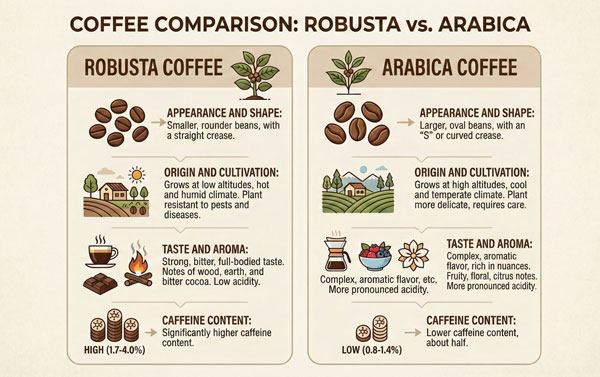
When discussing coffee beans, the first major distinction is between Arabica and Robusta, often combined in blends. It’s not just a matter of naming: the percentage of each type directly affects aroma profile, body, and creaminess.
Arabica is known for more complex and nuanced aromas: notes reminiscent of nuts, delicate cocoa, sometimes fresh fruit or floral hints, with a light acidity that keeps the beverage lively. It’s the ideal base if you enjoy a clean, elegant cup, especially when using an automatic machine set for balanced extractions.
Robusta, on the other hand, comes into play when you want structure, intensity, and thick crema. The flavor leans toward stronger, often more bitter tones, with a fuller body and a presence in the cup that’s hard to ignore. For this reason, many roasters include a portion of Robusta in blends intended for domestic use, giving that familiar “bar-style” push.
In practice, the most common combination for an automatic machine is a blend with a good percentage of Arabica (for example 60–70%) and a portion of Robusta (30–40%). This results in a balance between aroma and consistency. For a smoother cup, there are also 100% Arabica blends; alternatively, those seeking a stronger taste may opt for blends with a higher Robusta content—always keeping an eye on bean quality.
Roasting levels and performance in automatic machines
Even if you choose the best coffee beans, an unsuitable roast level can compromise the result in your automatic machine. Roasting is essentially the “cooking” of the beans, and it affects flavor, aroma, acidity, and even grinder maintenance.
A medium roast is generally the most recommended starting point for automatic machines. It enhances aromatic notes without pushing too much toward bitterness or burnt tones, while keeping acidity under control. With this type of roast, the beverage is balanced and versatile—ideal for both daily use and experimentation.
If you prefer a more intense cup, you can choose medium-dark roasts. These bring out stronger notes: dark chocolate, roasted nuances, sometimes hints reminiscent of wood or sweet tobacco. However, caution is needed: the darker the roast, the oilier the bean becomes on the surface. These oils may accumulate inside the machine over time, requiring more frequent cleaning of the hopper and grinder.
Very light roasts—often associated with Nordic styles or filter methods—are not ideal for most domestic automatic machines. Their acidity tends to be more pronounced and, if temperature and grind size aren’t perfectly calibrated, the result may taste too sharp or unbalanced.
Adjusting your machine to get the best out of your bean blends
Even the most carefully crafted blend needs a well-adjusted machine. Here’s where grind size, dose, and cup volume come into play. Think of it as a small control panel: small adjustments make a big difference.
If the drink tastes too bitter, dense, or burnt, the grind may be too fine or the dose too high. In this case, try selecting a slightly coarser setting or lowering the dose. If the liquid appears too light, under-extracted, and with little crema, you’re likely dealing with the opposite issue: choose a finer grind and, if possible, increase the dose slightly.
Another key factor is water quality. Excess hardness can flatten the flavor profile and increase scale build-up, while overly soft water may weaken the taste. Many manufacturers indicate the ideal hardness range: following these guidelines is a simple way to maintain consistent cup quality.
Finally, we come to maintenance: with daily use, oils and fine particles accumulate inside the brewing unit and grinder. A regular cleaning routine with automatic cycles and dedicated products helps keep the machine healthy and preserves the original flavor of the blends.
Choosing the main types of blends for automatic machines
On the market, you’ll find product lines of coffee beans specifically designed for automatic machines, often clearly stated on the packaging. Broadly, we can identify three main families, each with distinct characteristics.
100% Arabica blends focus on elegance and complexity: ideal for those who enjoy a smooth cup with a rich aromatic profile but without aggressive notes. Paired with a medium roast and balanced settings, they are an excellent choice for daily drinkers who prefer a refined sensation.
Balanced Arabica–Robusta blends are probably the most versatile category. They offer good intensity in the cup, satisfying crema, and stable results even for users who don’t fine-tune settings meticulously. These are often recommended for first-time automatic machine owners who want a result similar to what they get at their local café.
Lastly, there are stronger blends with high percentages of Robusta. The focus here is body and a stronger kick. They’re suitable for those who enjoy a bold morning cup. In such cases, it becomes even more important to check that the roaster specifies suitability for automatic machines, to avoid issues with excess oil or residue. In Italy, for example, renowned brands like Borbone have a long tradition of producing high-quality coffee beans.
| Aspect | Recommended choice | Reason |
|---|---|---|
| Type of bean | Blend with high percentage of Arabica | Greater finesse and aromatic richness |
| Crema and body | Addition of Robusta (20–40%) | Thicker crema and fuller body |
| Roast level | Medium roast | Stable and balanced results |
| Intensity | Medium-dark roast | Stronger and more structured flavors |
Practical criteria to choose your blend wisely
At this stage, choosing the best coffee beans for your automatic machine becomes mainly a matter of method. First, clarify what you expect in the cup: do you prefer a smooth and aromatic drink, or something more intense and structured? This initial choice already suggests the direction: higher Arabica percentages for the first case, more Robusta for the second.
Next, look at the roast level stated on the packaging. If you’re a beginner, start with a medium roast—an ideal baseline for balanced results. Only afterwards should you experiment with darker roasts, adjusting grind and volume accordingly.
A useful tip is to test two or three blends while keeping the same machine settings. This helps you understand how much the quality of coffee beans influences the result compared to the machine adjustments. When you find a combination you like, note the parameters (grind level, cup volume, strength setting) and use them as a reference for future comparisons.
Finally, don’t forget storage and consumption timing: it’s better to purchase bags with a recent roast date and use the beans within a few weeks after opening, resealing the bag properly or using airtight containers. This gives the blend a real chance to express its characteristics at their best.
In summary, the winning combination for most users is a balanced blend of Arabica and Robusta, medium or medium-dark roast, and a well-adjusted, clean machine. From here on, the rest is simply a matter of personal taste and curiosity to experiment.
Visita il nostro e-shop e scopri tanti prodotti a prezzi vantaggiosi!