


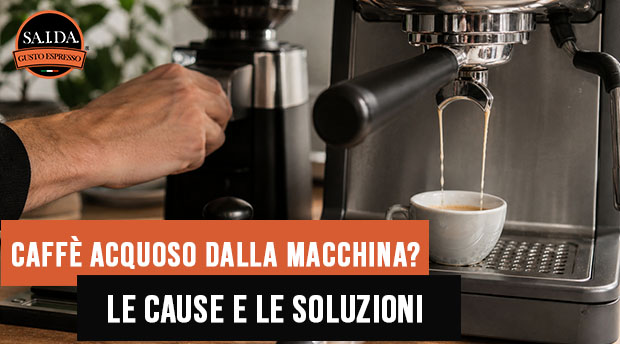
Watery Coffee with an Espresso Machine: Key Points and Solutions
- A grind that is too coarse abnormally speeds up the passage of water.
- The exact coffee dose ranges from 7 to 9 grams for a single filter.
- Tamping the coffee requires perpendicular pressure between 15 and 20 kilograms.
- Worn group head gaskets cause a loss of hydraulic pressure.
- A water temperature below 85°C prevents the extraction of essential oils.
Why does the coffee come out watery and without crema? The chemistry of extraction
Solving the issue of watery coffee coming out of your espresso machine requires an analysis of precise physical and mechanical parameters. A perfect espresso is obtained when hot water, pushed at high pressure, passes through the puck of coffee grounds, extracting aromatic compounds, sugars, and oils. If the extraction is too fast (under-extraction), the liquid in the cup appears transparent, lacks body, and has a sour taste. The main variables involved are the grind size, the dose, and the mechanical action.

1. Coffee grind too coarse
The grind size of the coffee regulates the contact time with water. Coffee grounds that are too coarsely ground do not provide sufficient hydraulic resistance. Water passes through the coffee puck too quickly, completing the extraction in 10-15 seconds instead of the standard 25-30 seconds needed for a volume of 25 milliliters. This dynamic produces an unbalanced and diluted drink. The immediate solution is to adjust the grinder burrs to a finer setting, thereby increasing the density of the puck.
2. Incorrect dose in the filter
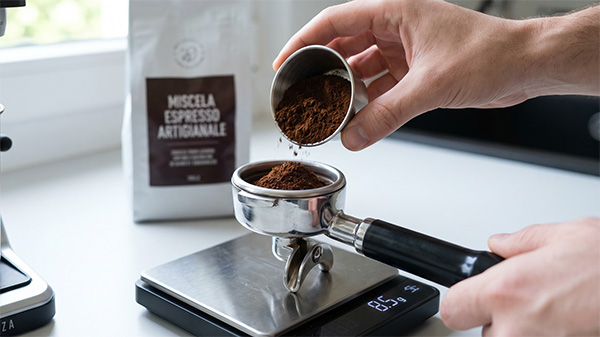
The amount of ground coffee directly affects the pressure generated inside the extraction chamber. A standard single filter requires a dose between 7 and 9 grams of ground coffee. A double filter requires an amount ranging from 14 to 18 grams. Using a dose below the standard creates excessive empty space (headspace) between the machine’s shower screen and the surface of the coffee. Water fills this space, breaks up the puck of grounds, and extracts an extremely diluted mixture. Using a precision scale corrects this issue at its source.
3. Weak or uneven tamping (Channeling)
The tamper levels and compacts the coffee inside the filter. Weak or uneven tamping creates the technical phenomenon known as “channeling.” Water delivered at 9 bars of pressure consistently chooses the path of least resistance. The fluid digs micro-channels through the uncompacted grounds, extracting only a minimal fraction of the available coffee. To avoid this problem, you need to apply perpendicular manual pressure of about 15-20 kilograms, ensuring a perfectly flat puck.
Technical and mechanical problems with the espresso machine
The absence of crema and the poor density of the drink do not depend solely on manual variables. The internal components of the coffee machine undergo thermal and hydraulic cycles that naturally lead to material wear.
Wear of the group head gasket
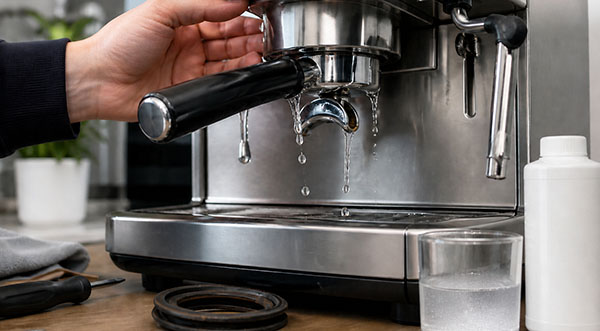
The group head gasket isolates the pressure chamber and seals the portafilter. This component, made of rubber or silicone, dries out and cracks due to continuous contact with boiling water. A damaged gasket causes liquid leaks and disperses the pressure required for extraction. Water escapes from the edges of the portafilter, preventing the proper emulsification of the coffee oils and making the drink flat and watery. Periodically replacing the gasket (ideally every 6-12 months) restores the airtight seal of the unit.
Drop in pump pressure and thermal anomalies
Preparing espresso requires an operating pressure of 9 bars to force water through the compacted grounds. A faulty or weakened vibration pump cannot generate the minimum thrust, compromising the extraction phase. At the same time, the thermoblock (or boiler) must deliver water at a temperature between 90°C and 96°C. Limescale buildup on sensors or heating elements prevents proper heat exchange. Water delivered at temperatures below 85°C is thermally unable to dissolve the fats and proteins in the bean. A deep descaling cycle with specific reagents often removes obstructions and restores boiler efficiency.
The influence of the blend and the freshness of the beans
The botany of coffee contributes to the result in the cup. Blends made from 100% Arabica beans develop a lighter body and a thinner crema. Adding a percentage of Robusta coffee (between 20% and 40%) significantly increases the viscosity of the liquid and the thickness of the surface crema. In addition, beans stored improperly lose the gases trapped during roasting (such as carbon dioxide), which are directly responsible for crema formation. Using fresh, sealed coffee ensures a full-bodied extraction.
When is it worth replacing the coffee machine?
Small household appliances have a life cycle defined by wear of the internal ducts and electronic components. Replacing the hydraulic pump or the main thermoblock, especially outside the warranty period, often results in repair costs that exceed the residual value of the appliance itself. In these scenarios, purchasing a new coffee machine is the most advantageous and safest choice in the long term.
This brief overview should help you with the simplest maintenance tasks to perform on your machine if you ever end up with watery coffee. We hope you found it useful.
Visita il nostro e-shop e scopri tanti prodotti a prezzi vantaggiosi!