

Espresso in capsules: how our break has changed
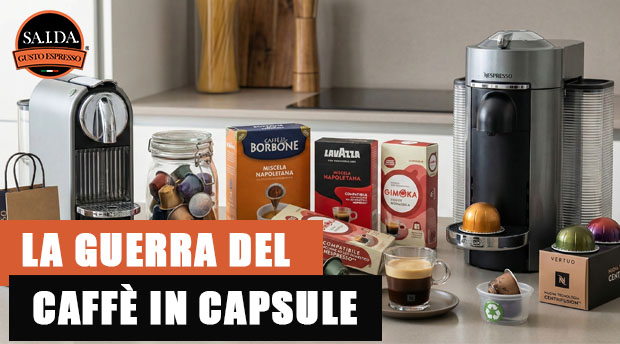
Looking back to the early years of the new millennium, drinking an espresso in capsules at home seemed almost a habit enjoyed by a select few. At the time, Nespresso stores, for example, were managed with a very refined and formal style, making the purchase experience similar to that of a luxury product. Nestlé, through the Nespresso brand, dominated the sector as the sole player, protected by a dense network of patents and a communication strategy focused entirely on exclusivity. Those who wanted the convenience of a cup ready in seconds were practically forced to remain within that system, with no real alternatives. Today, however, the situation is radically different, and we have moved from a closed-loop management system to an offering that can be found conveniently at the supermarket. Let’s see how this transformation has influenced our daily habits.
Coffee capsules: the era of the protected Nespresso system
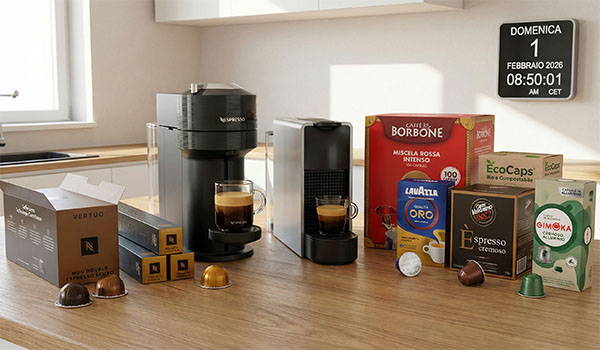
The initial success of this method was based on a very specific economic model: selling the machine at an affordable price and then requiring the user to purchase the original consumables produced by Nestlé. To protect this revenue, the company had filed approximately 1,700 patents covering every technical aspect, from the shape of the container to the way the water was pushed inside. In addition to legal protection, small mechanical variations were introduced into the devices, such as the position of the needles or the shape of the housing. These technical details made it difficult for other manufacturers to launch their coffee capsules without risking blocking the mechanism. It was an effective way to maintain total control over the supply chain and prices, leaving little leeway for those seeking savings or a different blend.
The legal turn that opened the market
The real turning point came between 2012 and 2014, when the judiciary and competition authorities began to intervene. In France, the Antitrust Authority ruled that Nespresso had to provide competitors with the technical details of new machines four months in advance, to prevent innovations from becoming insurmountable barriers. In Italy, the most famous dispute involved Caffè Vergnano before the Court of Turin. The judges clarified that producing compatible capsules was not a crime, but a right linked to the free circulation of products. From that moment on, the sector experienced a tremendous boost: it was no longer necessary to belong to an exclusive “club” to enjoy your favorite aroma, because a cup of coffee had finally become a commodity accessible to anyone shopping nearby.
The rise of Italian brands and new materials
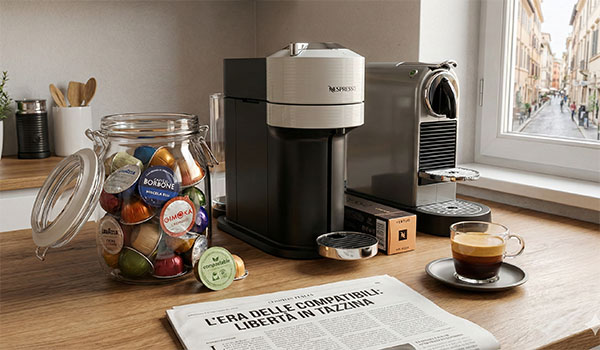
With the market doors open, Italian roasters have demonstrated how our tradition can make a difference in espresso in compatible capsules. Brands like Caffè Borbone have seen impressive growth, reaching a turnover of over €330 million in 2024 thanks to a strategy that focuses on an excellent quality-to-cost ratio. Alongside them, historic names like Lavazza and industrial companies like Gimoka have begun producing alternative solutions, initially in plastic and then evolving towards aluminum, which guarantees perfect protection against oxygen and light. This competition has led to constant improvement, including the development of compostable versions that can be disposed of in organic waste. Italian production has thus become a benchmark not only for the domestic market, but also for export throughout Europe.
The Vertuo system and the new exclusivity
Nestlé didn’t sit idly by while its product became mass-market. The response was the launch of the Vertuo system, which uses extraction technology based on centrifugal force instead of traditional pressure. The heart of this new exclusivity is a barcode printed on the edge of the dome, which the machine reads to regulate the temperature and amount of water. This system is protected by new patents that won’t expire until 2029 or 2030, making it currently impossible to find legal compatible capsules for this specific format. It’s an attempt to recreate the protected environment of the early days, aimed at those who prefer longer formats or like the idea of advanced technology in the kitchen. However, the classic system remains the favorite of most users who enjoy supermarket variety.
The final advantage for the consumer
If today we can choose from dozens of different blends from different coffee brands like Borbone, Lavazza, Lollo, and others, we owe it precisely to the spread of compatible capsules. This commercial battle has brought tangible benefits for us: prices have dropped significantly, from around 50 cents at the beginning to figures that often hover between 15 and 25 cents, especially in the economy sizes. We have gained the freedom to change flavors whenever we want, supporting local roasters or focusing on major national brands. The cup has become more democratic, and the average quality has risen precisely thanks to competition. Whether you prefer the intensity of a Neapolitan blend or the sweetness of an Arabica, today, all it takes is a button press and a few cents to get exactly what you want. It was a positive transformation that put us and our personal taste at the center.
Visita il nostro e-shop e scopri tanti prodotti a prezzi vantaggiosi!